.png&w=96&q=75)
The Question Behind the Question
When someone calls us about a network project, the question they ask is usually "how much does this cost?" The question underneath it is "why does this company sometimes want $499 before they'll even tell me?"
It's a fair thing to want answered before you book anything. Every technology installer in Northern Virginia will come to your property, walk around for 15 minutes, and hand you a number. It costs you nothing, and for a lot of properties that's exactly the right amount of process. For others, it tells you almost nothing — and the gap between those two properties is what this article is about.
We use four different engagement paths, not one. Which one applies to you depends on how well defined your project already is, not on how much you're planning to spend.
The Four Paths, and What Each One Actually Is
Skipping straight to a price assumes we already know what the property needs. Sometimes we do. Sometimes we don't — and the honest answer is to say so before quoting anything.
1. Initial Project Review — no charge, non-binding
A conversation, not a site visit. We ask about the property, the symptoms, the scope, and what you already know. It confirms whether we're a fit and points you to the right next step. This is not a technical assessment, and we don't pretend it is one.
2. Direct Quote — for confirmed, tightly scoped work
When the scope is already clear — a standard Starlink install, a single-structure WiFi job — we quote it directly. A Direct Quote isn't guaranteed for every inquiry; it's appropriate when the work is genuinely well defined, not when we're hoping it is.
3. On-Site Infrastructure Assessment — $499, approximately 60-90 minutes
A paid, on-site diagnosis for properties where the cause of a problem — or the shape of a new project — isn't clear from a conversation alone. It is not a disguised free estimate, and it isn't mandatory for every project. It exists for the properties where guessing is expensive.
4. Infrastructure Architecture Plan — for complex or staged projects
A separate, larger engineering deliverable for complex estates, multi-building properties, new construction, and major renovations. It is not something every assessment leads to, and it does not carry an automatic credit toward implementation the way the $499 assessment does.
Most inquiries resolve at step one or two. The assessment and the Architecture Plan exist for the properties where they're actually the honest answer — not as an upsell path every caller gets funneled through.
Who Needs an Assessment, and Who Probably Doesn't
A free 15-minute walkthrough works fine when the property and the problem are simple. Here's what that actually looks like in practice, and what doesn't fit it.
Skip the assessment if:
Single structure, clear line of sight — standard Starlink installation ($899)
Apartment or townhome WiFi optimization — straightforward mesh deployment
Single-room coverage problem — a targeted diagnostic visit, not a full assessment
Get the assessment if:
Multi-building property — barn, guest house, pool house, detached garage
Business-critical internet needs — remote executive, telemedicine, trading
Estate with existing failed installation — consumer mesh that doesn't work
Complex terrain — wooded lots, elevation changes, metal roofing, stone walls
You want a second opinion before spending $5,000+ on technology infrastructure
For standard installations, go directly to Starlink Installation or WiFi Engineering. No assessment needed. If you're comparing installer tiers before committing, see our honest breakdown of retail vs professional network installation.
What Gets Determined Remotely, and What Requires Being On Site
A phone call can establish the property type, the rough square footage, the number of structures, and the symptoms you're experiencing. What it cannot establish is how radio frequency actually behaves inside your specific walls — and that gap is the entire reason the assessment exists.
Stone, plaster-and-lathe, low-E glass, and metal roofing each attenuate signal differently, and two houses that look similar from the street can behave completely differently once you're inside them. A wooded lot in Great Falls and an open lot in Loudoun County with the same square footage can need entirely different equipment counts for the same coverage result. That's not guesswork we can shortcut over the phone — it's the reason a site visit exists at all.
Roughly 60-90 Minutes On-Site
A focused on-site visit reviewing structure, cable paths, provider setup, and the areas where coverage or failover has been a problem — not an all-day survey.
Structure & Coverage Review
Building materials, layout, and the specific dead zones or failure points that a 15-minute walkthrough misses.
Failure-Point & Risk Review
Single points of failure, weather exposure, and power-continuity gaps identified against how the property is actually used.
Written Findings & Direction
A written summary of what was observed and a recommended project direction — a document you keep and can take to any installer.
Before the visit, it helps to have your provider account details on hand, know where your current equipment is located, and be ready to point out any rooms or outdoor areas where coverage has been a known problem. None of that is required — we'll find it either way — but it shortens the visit.
The assessment follows The Orbit Protocol, our four-phase engineering methodology. It's the same process whether the project is an $899 Starlink installation or a large multi-building estate network — the scope changes, the discipline doesn't.
What an Assessment Helps You Avoid
Without an on-site assessment, complex installations can hit one of these cost multipliers:
| Problem | Typical Cost Impact |
|---|---|
| APs placed in wrong locations → re-run cables | +$800–$1,500 |
| Wrong equipment for building materials → replace hardware | +$600–$2,000 |
| No failover planning → second installation visit | +$1,200–$3,000 |
| Undersized for future capacity → full replacement in 2 years | +$3,000–$8,000 |
| No cable management plan → messy retrofit | +$400–$1,200 |
These are illustrative ranges from the kinds of rework we get called in to fix, not a quote for your property. On a $6,000 estate project, avoiding even one of them can offset the cost of the assessment several times over.
And if you proceed with us: 100% of the $499 assessment fee is credited toward your project. The Architecture Plan, when one is warranted, is priced and scoped separately and doesn't carry that same automatic credit.
Real Example: The Potomac Estate
A U.S. Navy surgeon in Potomac, MD needed mission-critical internet for telemedicine and research. His previous consumer setup failed during critical video calls. Three different installers had quoted him "whole-home WiFi" solutions ranging from $2,500 to $4,000 — all essentially recommending the same consumer mesh equipment he'd already tried.
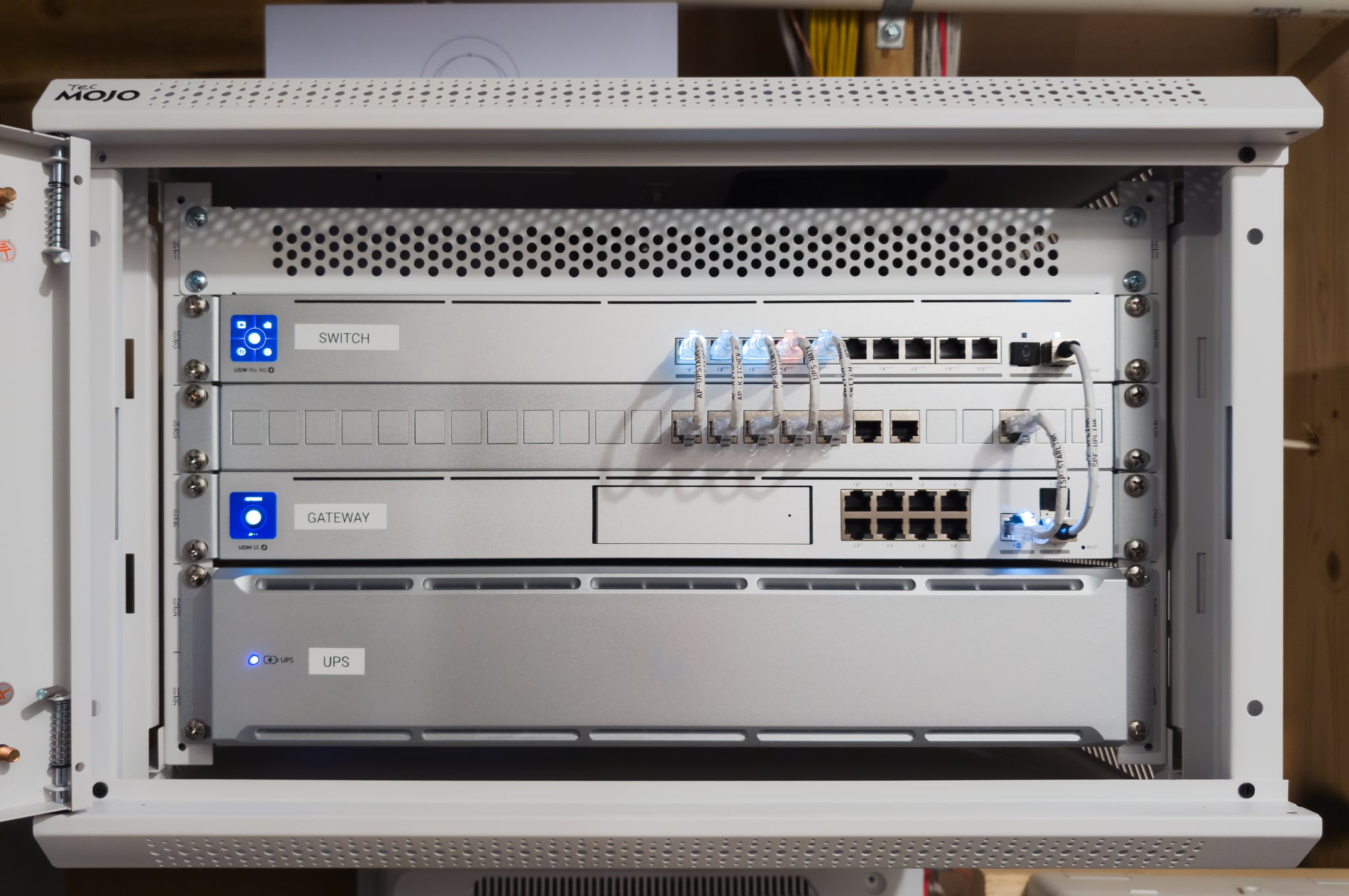
Our assessment revealed the actual requirements: dual-WAN failover (not just better WiFi), enterprise-grade access points rated for his home's plaster-and-lathe walls (not consumer mesh), and a pure sine wave UPS protecting the entire network stack. None of that was visible from a walkthrough — it came from measuring how the existing system was actually failing.
The final system cost $7,950 — more than the consumer quotes, but engineered for a completely different outcome. The project record documents dual-WAN failover, WiFi 7 coverage, and UPS-protected network infrastructure designed around the client's telemedicine and research work.
What You Understand Afterward
You receive the assessment findings after the on-site work — delivery is scheduled by scope. It includes:
Current-condition review of the existing setup
Major failure-point and coverage observations
Structure, provider, cable-path, and failover review
A recommended project direction and rough scope
Written findings or scope summary you keep
The document is yours. If you want to give it to a different installer, that's your right. We earn your implementation business by designing the best system — not by locking you in.
Most clients proceed with us because the assessment demonstrates the depth of engineering we bring. But the findings hold regardless of who implements them, and if the property turns out to need the larger Architecture Plan instead — a full multi-building redesign, for example — we'll say so plainly rather than stretch the $499 assessment to cover work it wasn't scoped for.


